Before you start
Leave a note that still distinguishes the background, decision and next action after the conversation fades.
- First step
- Rewrite one ambiguous note using a useful title, one context sentence and a concrete next action.
Done when
- A future reader can tell what was decided and what still needs to happen.
- Links name their purpose, and completed material has a deliberate review or archive decision.
Limit of this method: A structured note is a memory aid; it does not verify the underlying facts or replace an authoritative record.

Preserve useful distinctions so a note still makes sense after the conversation fades.
Free text worksheet. No signup. Fill it locally; the site does not receive your entries.A note can be accurate and still become confusing a week later. Call back makes sense while the conversation is fresh. Later, it may not tell you whom to call, what to ask or where the relevant document lives.
You do not need an elaborate knowledge system to fix this. A small repeatable template gives a note enough context to remain useful. This guide suggests an editorial method; it does not depend on a particular app.
Give the note a useful title
Use a subject and a purpose. Apartment repair questions is easier to find than Monday note. Add a date when the note describes a specific event or decision.
Avoid placing unnecessary private identifiers in the title. Titles can be exposed in recent lists and screenshots. Use a neutral label when the full detail belongs inside a private document.
A title should help you decide whether to open the note. It does not need to contain every detail of the content.
Record context in one sentence
Write why the note exists. For example: I am comparing two repair options before booking a visit. That sentence gives later bullets a frame of reference.
If the note records a meeting or call, identify the subject and date. Distinguish what someone said from what you inferred. A statement such as the contractor said parts may take a week preserves uncertainty better than parts arrive next Friday.
Do not turn a rough note into a factual claim it cannot support. Preserve approximate amounts, unresolved questions and tentative decisions as such.
Separate facts, decisions and actions
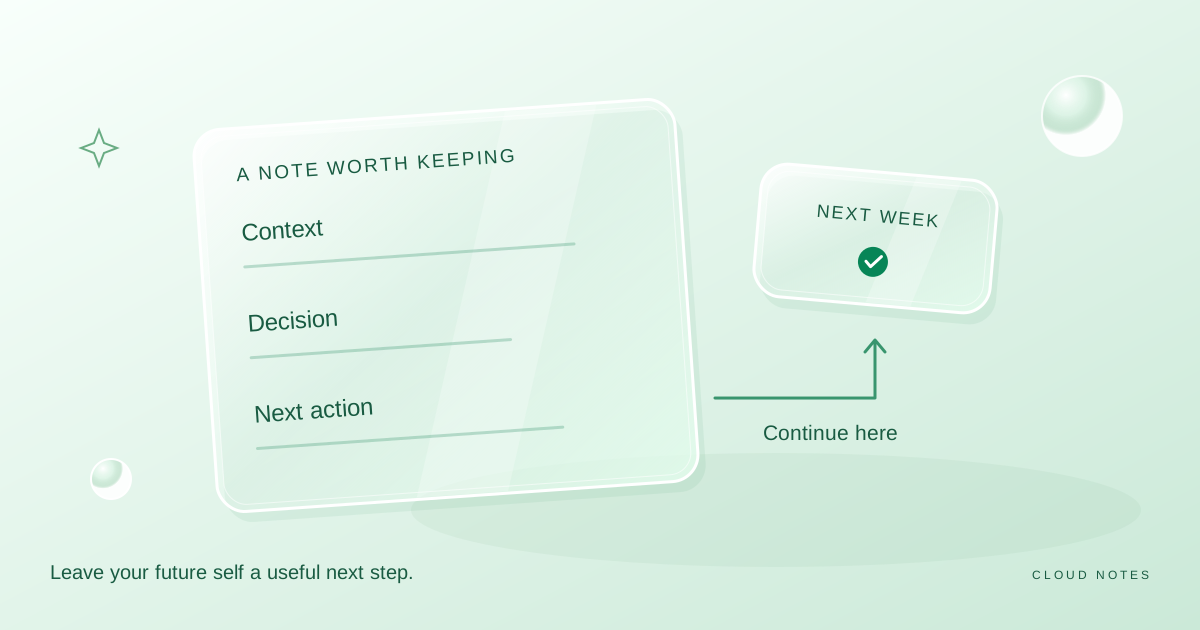
Use three short sections. Facts contain relevant observations and sources. Decisions contain choices already made. Next actions contain work still to do.
For a travel note, a fact might be that an option was available when checked. A decision might be to prefer the early arrival. The next action might be to confirm the price and booking terms. Keeping these separate prevents an old observation from looking like a current commitment.
When information can change, include when you checked it and a link to the source. Do not rely on an old note for live availability, current policy or pricing without checking again.
Make the next action executable
Use a verb and an object. Ask the repair company whether the quote includes materials is more useful than check quote. Include a deadline only when one exists or when you deliberately choose it.
If the action depends on another person, record the dependency. Waiting for the landlord's approval is different from ready to book. This helps you choose work you can actually move forward today.
Keep the next action small enough to start. A note saying organise all documents may need to become file the three new receipts in the appliance folder.
Link to the material, with a reason
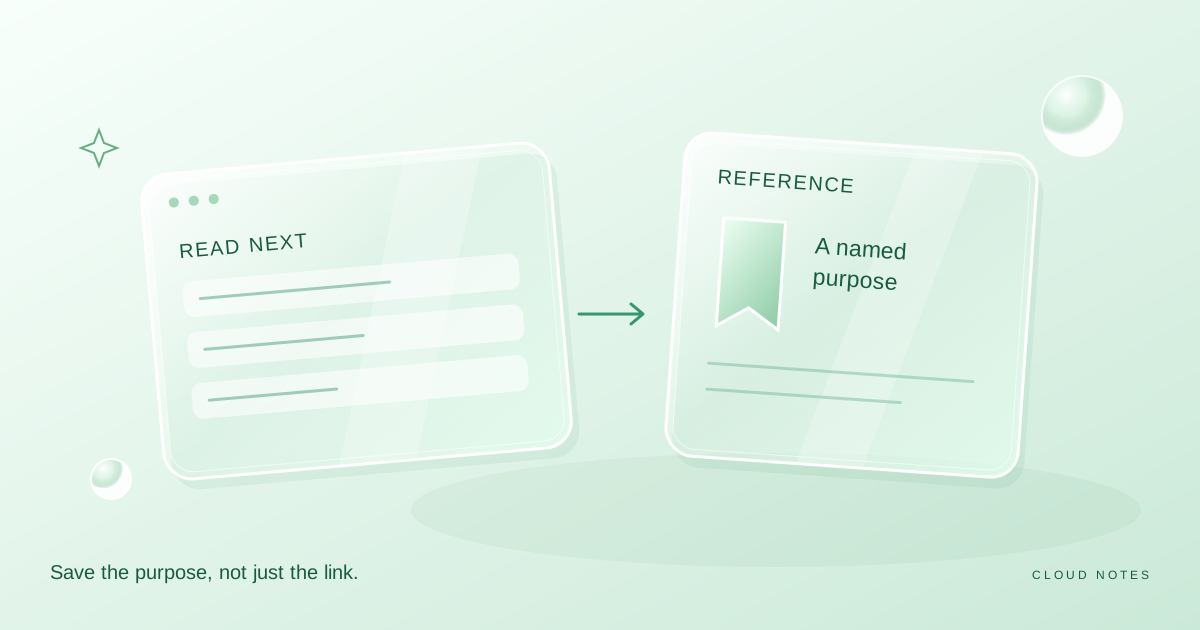
A bare link gives a location. A sentence explaining why the link matters gives context. For example: This manual contains the model number and filter replacement instructions.
If the linked material is a file, use its stable home rather than a temporary download you plan to delete. If it is a web page, keep the page title and date checked when the content affects a decision.
Do not copy large amounts of third party text into a personal publishing workflow without considering rights and attribution. A short summary in your own words with the source link is often easier to maintain.
Review and archive deliberately
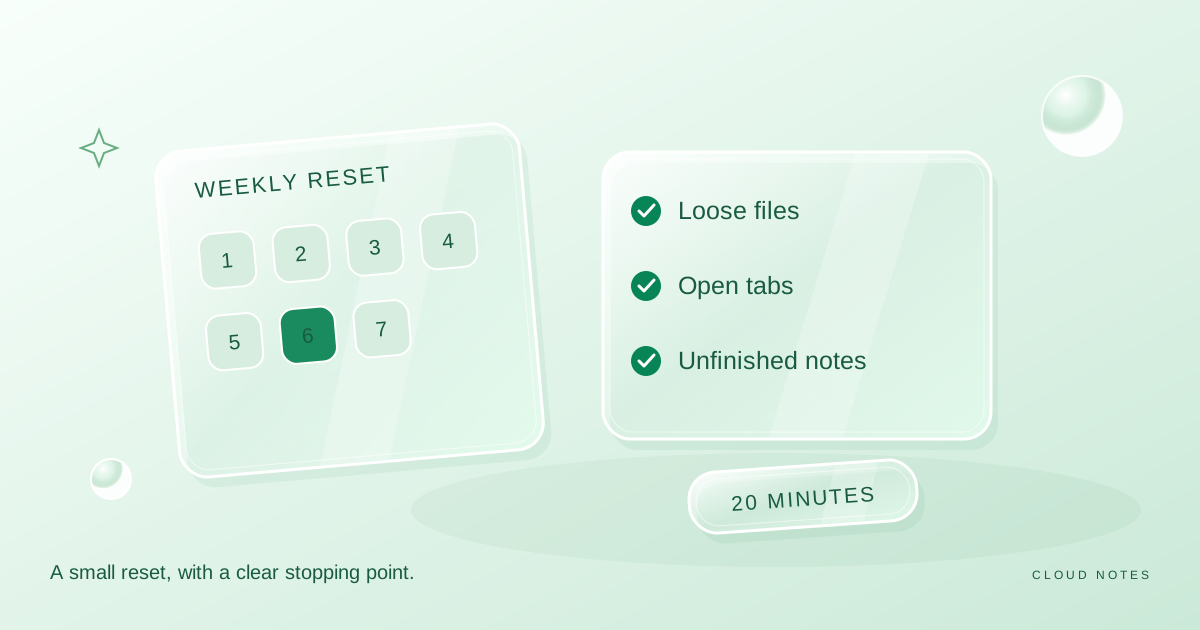
During a weekly reset, decide whether each active note still has a next action. Completed notes can move to Reference or Archive. Useful ideas can remain in an idea list without a false deadline.
Split a note when it contains two unrelated decisions. Keep a note together when its parts explain one outcome. Creating hundreds of tiny fragments can make retrieval as difficult as keeping one enormous file.
Use a small test: open a note from last week and try to continue the task without consulting your memory. If you cannot, add the missing context and improve the template.
A template to copy
- Title: subject and purpose.
- Context: why this note exists.
- Facts: what is known, with sources where needed.
- Decisions: what has actually been chosen.
- Next action: the smallest useful step and any dependency.
- Links: where the supporting material lives and why it matters.
- Review: when the note needs another look.
Rewrite one ambiguous note
Start with a fictional note: repair quote, call Tuesday, ask about parts. Its meaning is clear only while the original conversation is fresh. A more useful version preserves the uncertainty instead of filling the gaps with assumptions.
| Section | Example entry | Why it helps |
|---|---|---|
| Context | Comparing repair options before booking | Explains the decision being made |
| Fact | Supplier said parts may take about a week | Keeps the original uncertainty |
| Decision | No booking made yet | Prevents an option becoming a false commitment |
| Next action | Ask whether the quote includes materials | Creates an executable step |
| Supporting material | Current quote in Active / Appliance repair | Gives the file a stable location |
If Tuesday was your chosen review date rather than the supplier's promise, say that. Notes become unreliable when a tentative observation gradually turns into a firm statement without new evidence.
You can keep this in plain text. The quality comes from the distinctions, not an app's formatting. A useful retrieval test is to return to the note a week later and identify the next action without reconstructing the call from memory.
Keep the note maintainable
When the decision changes, add a dated update or clearly replace the obsolete action. Do not keep two conflicting next actions with no indication of which is current. Move completed tasks out of the active view while retaining the reasoning if it still matters.
Download the note template and try it on one current task. If the note relies on several web pages, use the bookmark guide to give those links a retrievable purpose.
Common questions
Should every note use the full template?
No. A quick grocery list does not need a decision log. Use the sections that preserve the context you are otherwise likely to lose.
Can I keep notes in plain text?
Yes. The method depends on clear writing and a retrievable location, not a specific format.
Examples are illustrative planning exercises unless a source says otherwise. Read our editorial policy for sources, AI assistance and corrections. See example data and checking methods for reproducible calculations and practice files.